

Consent Software in 2026: 7 Live Checks Before You Buy
A useful guide to consent software should help readers understand both the rule and the behavior behind the rule. That is where consent topics become genuinely practical instead of sounding like recycled compliance copy.
The linked DataShyre articles cover the nearby topics, while this explainer should stay focused on plain-English direction for publishers, operators, and marketers.
If you want nearby context first, start with these guides to consent management platform, consent manager, and consent management provider. This page is narrower. It is the seven-check review I would use this week before buying or renewing any consent software.

Why consent software now has to be reviewed like infrastructure
The regulatory baseline is still practical, not theoretical.
The European Commission still says valid consent must use “clear and plain language” and that withdrawal must be “as easy to use as giving consent.” The UK’s ICO finalized its storage-and-access-technologies guidance on April 29, 2026 and says a consent mechanism must “function as intended.” California’s Department of Justice still describes Global Privacy Control as a “stop selling or sharing my data switch.” Google’s website consent documentation still says default consent states should be set “before any commands that send measurement data.”
That combination changes the buying test. Good consent software is not only a banner tool. It is a control layer for notice, choice, signaling, enforcement, and proof.
1. Start with whether the first layer gives a fair choice
The first live test for any consent software is whether a person sees a fair choice immediately.
That means checking the interface, not only the admin screenshots.
The Commission’s consent guidance still expects a specific, informed, affirmative act in “clear and plain language.” California’s dark-pattern enforcement also pushes toward symmetrical choice rather than nudging people into acceptance. In real deployments, the first layer should let a normal person refuse as easily as accept.
Before you compare checklists, test this:
- Is
Reject allpresent whereAccept allis present? - Is the privacy-protective option equally visible on mobile?
- Are category labels plain enough that a non-lawyer can follow them?
- Can the user reopen settings without hunting through the footer?
If the answer is no, the consent software is already asking the user to absorb the compliance gap.
2. Verify that optional technologies stay off before choice
This is where a lot of consent software looks compliant and still fails in production.
The ICO’s current guidance is useful because it is not limited to cookie names. It covers cookies, tracking pixels, scripts, device fingerprinting, and similar storage-or-access technologies. So the test page is not just the homepage. It is also the article page with embeds, the product page with analytics, the landing page with ad tags, and the logged-in view with personalization code.
This is why the live browser check matters more than the sales deck:
- load a fresh session;
- inspect what fires before any click;
- accept, reject, and withdraw;
- compare what changes in the browser and network panel each time.
If optional technologies still run before the choice where prior consent is required, the consent software is recording a preference after the fact instead of enforcing it beforehand.
3. Make regional branching part of the buying decision
One consent software deployment may need to handle the EU, UK, California, and other U.S. states at the same time.
That does not mean one legal branch is enough.
For EU and UK traffic, the usual question is whether optional storage or access waits for valid prior consent. For California traffic, the review may shift toward opt-out handling, browser-based privacy signals, and whether sale or sharing choices flow across linked properties and accounts. On February 11, 2026, California Attorney General Rob Bonta announced Disney’s $2.75 million settlement over failures to fully effectuate opt-out requests across associated devices and streaming services.
So when evaluating consent software, deliberately test:
- an EU or UK first visit with no saved preference;
- a California visit where opt-out rights apply;
- a GPC-enabled browser;
- a return visit after refusal or withdrawal; and
- whether the language shown to the person still matches the branch they are actually in.
If a product demo collapses all of that into one generic banner story, the consent software may be thinner than it looks.
4. Split out Google’s publisher and tag requirements
This is one of the most missed consent software checks.
General privacy compliance and Google’s own publisher or tag requirements overlap, but they are not the same review.
Google’s current publisher guidance still says partners using AdSense, Ad Manager, or AdMob and serving personalized ads to users in the EEA, UK, or Switzerland must use a Google-certified CMP integrated with the IAB Transparency and Consent Framework. Google also says certification “does not check the tool for full compliance” with applicable privacy laws. Separately, Google’s website consent-mode guidance still says default consent commands should run “before any commands that send measurement data.”
That means a serious consent software review should ask two separate questions:
- does the product satisfy the Google-specific requirement that applies to your ad stack; and
- does the implementation still satisfy your broader legal and operational review.
Passing one of those tests does not automatically answer the other.
5. Compare products by operating model, not marketing category
The most useful consent software comparison is not “enterprise” versus “lightweight.” It is what operating model the product actually supports.
Current vendor materials make that visible quickly:
- OneTrust emphasizes region- and device-aware consent flows and tracker blocking until consent is received.
- Didomi emphasizes centralized consent collection across websites, mobile apps, connected devices, and preference-management paths.
- Ketch emphasizes server-side consent records, cross-device enforcement, and downstream propagation into systems like CRMs and CDPs.
- Osano emphasizes unauthorized-tag blocking, GPC and framework toggles, and lower-overhead deployment for web teams.
That does not mean one of these is universally the best consent software. It means buyers should match the tool to the operating problem:
- ad-supported publisher requirements;
- multi-brand or multi-region rollout;
- web-plus-app consent synchronization;
- downstream enforcement outside the browser; and
- the amount of engineering or privacy-ops support available internally.
The best buying question is not “which platform has the most features?” It is “which product matches the runtime and governance problem we actually have?”
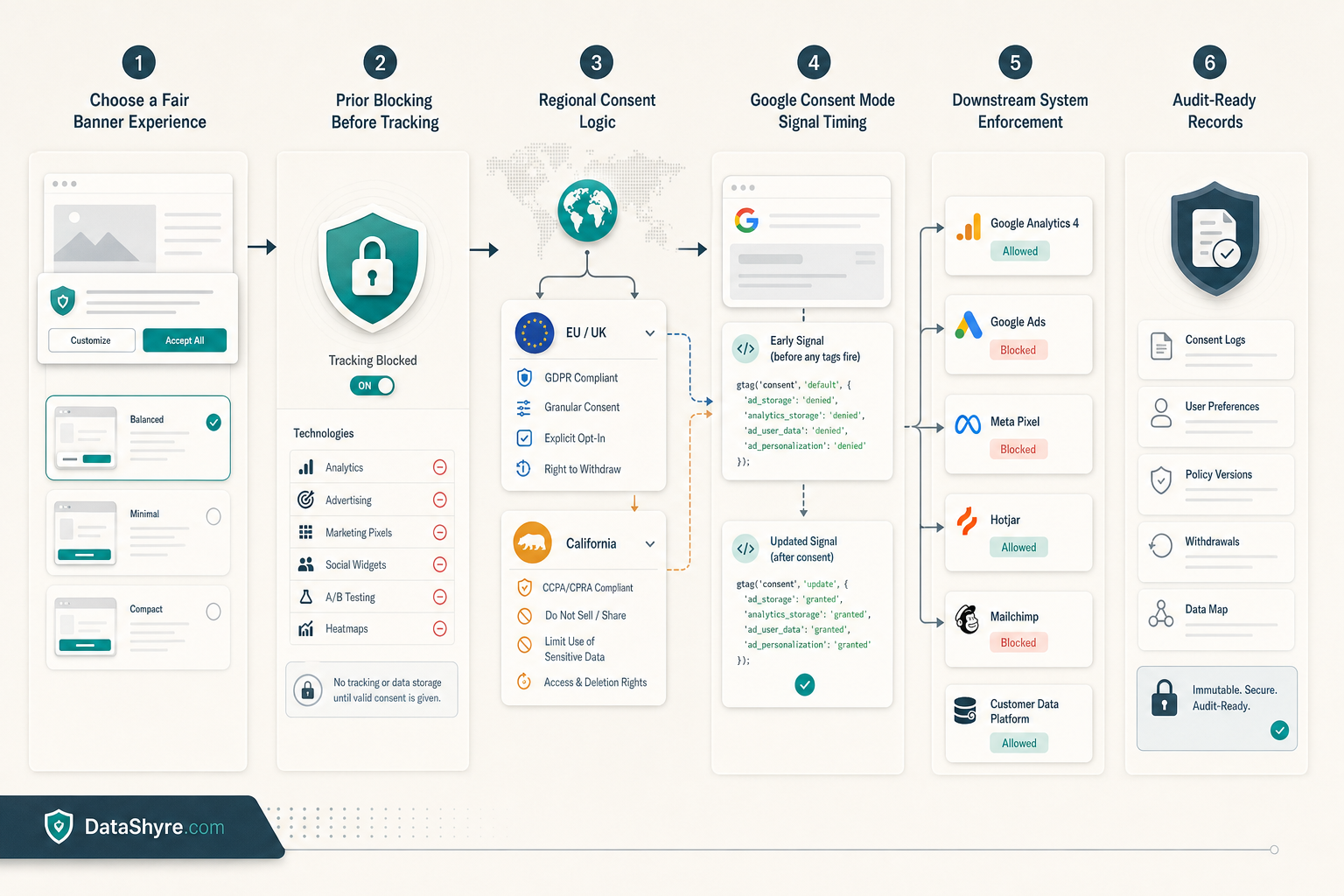
6. Inspect the evidence model, not only the preference table
Strong consent software should help your team explain what happened after the stack changes.
That usually means the records can answer:
- what notice or banner version the person saw;
- what categories or purposes were offered;
- what they chose and when;
- what region or ruleset applied; and
- whether the live system behavior matched the recorded state.
The ICO’s consent guidance is helpful here because it focuses not just on obtaining consent, but also on recording what people were told at the time and how they can withdraw later. If the software only stores accepted or rejected without enough surrounding context, the proof is thinner than it looks.
7. Price for enforcement and maintenance, not only for the banner
The sticker price is often the least accurate way to estimate consent software cost.
The real bill can include:
- tag-manager changes;
- direct-script cleanup;
- embed blocking;
- app and web branch testing;
- consent-log retention and exports;
- regional rule maintenance; and
- re-testing after marketing or engineering changes.
This is why the cheapest visible plan is not automatically the cheapest consent software choice. A lower subscription can still create a more expensive operating model if it leaves your team patching the gaps in GTM, app code, or downstream systems.
A short review order for this week
If I were evaluating consent software today, I would use this order:
- compare
Accept allandReject allon desktop and mobile; - test what fires before choice on the pages most likely to leak;
- run separate EU or UK, California, and GPC paths;
- verify Google consent-mode timing and publisher-specific requirements where relevant;
- compare products by operating model rather than vendor category;
- inspect whether the evidence model still explains what happened later; and
- budget for enforcement and maintenance, not only the banner.
That usually tells you more than another feature matrix.
FAQ
Is consent software the same thing as a CMP?
Often the terms overlap. The more useful question is whether the tool actually manages notice, choice, signaling, enforcement, and proof in a way your team can verify.
Do all teams need enterprise consent software?
No. Some sites need a solid web CMP and good testing discipline more than a large privacy suite. Others need cross-device enforcement, app support, publisher-ad compatibility, or preference synchronization across many systems.
If the software is Google-certified, is that enough?
No. Google’s own guidance says certification does not determine full compliance with applicable privacy laws. It answers a narrower Google-specific requirement.
Bottom line
The best consent software in 2026 is not the tool with the loudest feature page.
It is the tool that gives a fair first choice, holds optional technologies until it should, branches correctly by region, sends the right signals at the right time, leaves behind records another team can still understand later, and fits the operational model your business actually runs.
Seen clearly, consent software is less about a pop-up and more about whether the site behaves honestly after the visitor makes a choice.
Sources
- European Commission, legal grounds for processing data: https://commission.europa.eu/law/law-topic/data-protection/information-business-and-organisations/legal-grounds-processing-data_en
- ICO, final storage and access technologies guidance published: https://ico.org.uk/about-the-ico/media-centre/news-and-blogs/2026/04/final-storage-and-access-technologies-guidance-published/
- ICO, how do we manage consent in practice?: https://ico.org.uk/for-organisations/direct-marketing-and-privacy-and-electronic-communications/guidance-on-the-use-of-storage-and-access-technologies/how-do-we-manage-consent-in-practice/
- California DOJ, CCPA and Global Privacy Control: https://oag.ca.gov/privacy/ccpa
- California DOJ, Disney settlement announcement: https://oag.ca.gov/news/press-releases/california-wont-let-it-go-attorney-general-bonta-announces-275-million
- CPPA, Enforcement Advisory No. 2024-02: https://cppa.ca.gov/pdf/enfadvisory202402.pdf
- Google for Developers, set up consent mode on websites: https://developers.google.com/tag-platform/security/guides/consent
- Google AdSense Help, consent management requirements for serving ads in the EEA, the UK and Switzerland: https://support.google.com/adsense/answer/13554116
- OneTrust, consent management platform: https://www.onetrust.com/products/consent-management/
- Didomi, consent and preference management platform: https://www.didomi.io/
- Ketch, consent management platform: https://www.ketch.com/platform/consent-management
- Osano, consent management platform: https://www.osano.com/solutions/consent-management-platform
—
Published: October 21, 2026. Updated using current official regulator, government, Google, and vendor materials available at publication time.