

Consent Management Platform Pricing in 2026: 7 Cost Checks Before You Sign
A useful guide to consent management platform pricing should help readers understand both the rule and the behavior behind the rule. That is where consent topics become genuinely practical instead of sounding like recycled compliance copy.
The linked DataShyre articles cover the nearby topics, while this explainer should stay focused on plain-English direction for publishers, operators, and marketers.
That matters because the live compliance baseline is still operational. The European Commission still says consent requests should use “clear and plain language” and that it should be “as easy to withdraw as to give consent.” The UK’s ICO finalized its storage-and-access-technologies guidance on April 29, 2026, and says any consent mechanism must “function as intended.” Google’s current website consent documentation still says defaults should be set before any commands that send measurement data. In California, the Department of Justice still describes Global Privacy Control as a “stop selling or sharing my data switch.”
If you want nearby context first, start with these guides to consent management platform, cookie consent platforms, and consent management systems. This page is narrower. It is the pricing review I would use this week before signing a CMP contract.

1. Identify the meter before you compare the price
The first pricing mistake is comparing monthly numbers without checking what triggers the bill.
Public self-serve pricing already shows why this goes sideways fast. CookieYes says it counts a pageview each time a page with its code is loaded or reloaded. Cookiebot says its pricing depends on the number of domains and the number of subpages per domain, and that the subscription price is calculated from the highest page count recorded during scan history.
Those are not small accounting details. They create different budget risks:
- a high-traffic site with relatively few URLs may dislike pageview-based billing;
- a large documentation or ecommerce site with many URLs may dislike page-count billing;
- a multi-brand group may discover that domain count matters as much as traffic.
So before you compare vendors, reduce the problem to the real driver:
- monthly pageviews;
- number of domains or properties;
- number of subpages or scan depth; and
- whether overages are possible.
If you skip that step, the CMP budget looks simpler than it is.
2. Separate base plan price from compliance scope
A second mistake is assuming that the cheapest paid plan covers the controls your legal model actually needs.
That is often false. On its public pricing page, CookieYes shows that features such as geo-targeting, IAB TCF support, Global Privacy Control, and higher scanning capacity sit in higher plans. That is normal across the category: entry pricing often gets you a banner and basic scans, while more demanding regional logic, reporting, or framework support lives further up the ladder.
This is where current legal expectations matter. The Commission’s consent guidance still expects specific purposes, a clear affirmative act, visible withdrawal, and “clear and plain language.” If your operating reality spans the EU, UK, California, and ad-tech tooling, your usable plan is not necessarily the lowest listed price.
For a real CMP budget, I would therefore split costs into two columns:
- interface cost: banner, basic customization, standard scans;
- scope cost: geo rules, framework support, GPC handling, higher scan capacity, logs, and reporting.
That simple split prevents a common buying mistake: paying entry-level pricing for enterprise-level expectations.
3. If you serve Google publisher ads, treat that as a separate budget branch
This is one of the biggest blind spots in CMP pricing.
Google’s current AdSense guidance still says publishers serving personalized ads to users in the EEA, UK, or Switzerland must use a Google-certified CMP integrated with the IAB Transparency and Consent Framework. Google also says CMP certification does not confirm full compliance with privacy law.
That changes pricing in two ways:
- it can narrow your vendor shortlist immediately; and
- it can push you into plans or products that include TCF support, publisher-oriented features, or a different implementation path.
So if your site runs AdSense, Ad Manager, or AdMob inventory, do not mix that requirement into the generic web-banner budget. Price it as its own branch:
- certified-CMP eligibility;
- TCF support;
- Google consent-signal setup and testing; and
- publisher-specific rollout effort.
For some teams, this is the moment when CMP pricing stops being a plugin decision and becomes an ad-operations decision too.
4. Price California opt-out behavior, not just the banner
A lot of CMP comparisons still price for the first layer and underprice the downstream workflow.
California is the fastest way to see that gap. The California DOJ’s current CCPA guidance says GPC is a “stop selling or sharing my data switch” and that covered businesses must honor it as a valid consumer request. On February 11, 2026, Attorney General Rob Bonta announced California’s $2.75 million Disney settlement and said asking a business to stop selling data should not be “complicated or cumbersome.” The DOJ said Disney had failed to fully effectuate opt-out requests across devices and services tied to the same account.
That is a pricing issue as much as a legal one. If your business links users across apps, web properties, logged-in accounts, or ad-tech systems, the real cost may include:
- cross-property preference propagation;
- GPC recognition;
- opt-out handling beyond the browser banner;
- testing across web, app, and account surfaces.
So when you review a CMP budget, ask whether the plan price covers a banner only or the broader opt-out system your business actually needs.
5. Treat implementation and runtime testing as part of the CMP bill
This is where many low-cost CMP decisions become expensive later.
Google’s current implementation guide still says the default consent state should be set on every page before any commands that send measurement data. The ICO’s 2026 guidance also makes clear that the practical review surface includes cookies, tracking pixels, scripts, device fingerprinting, and similar technologies, and that any consent mechanism must “function as intended.”
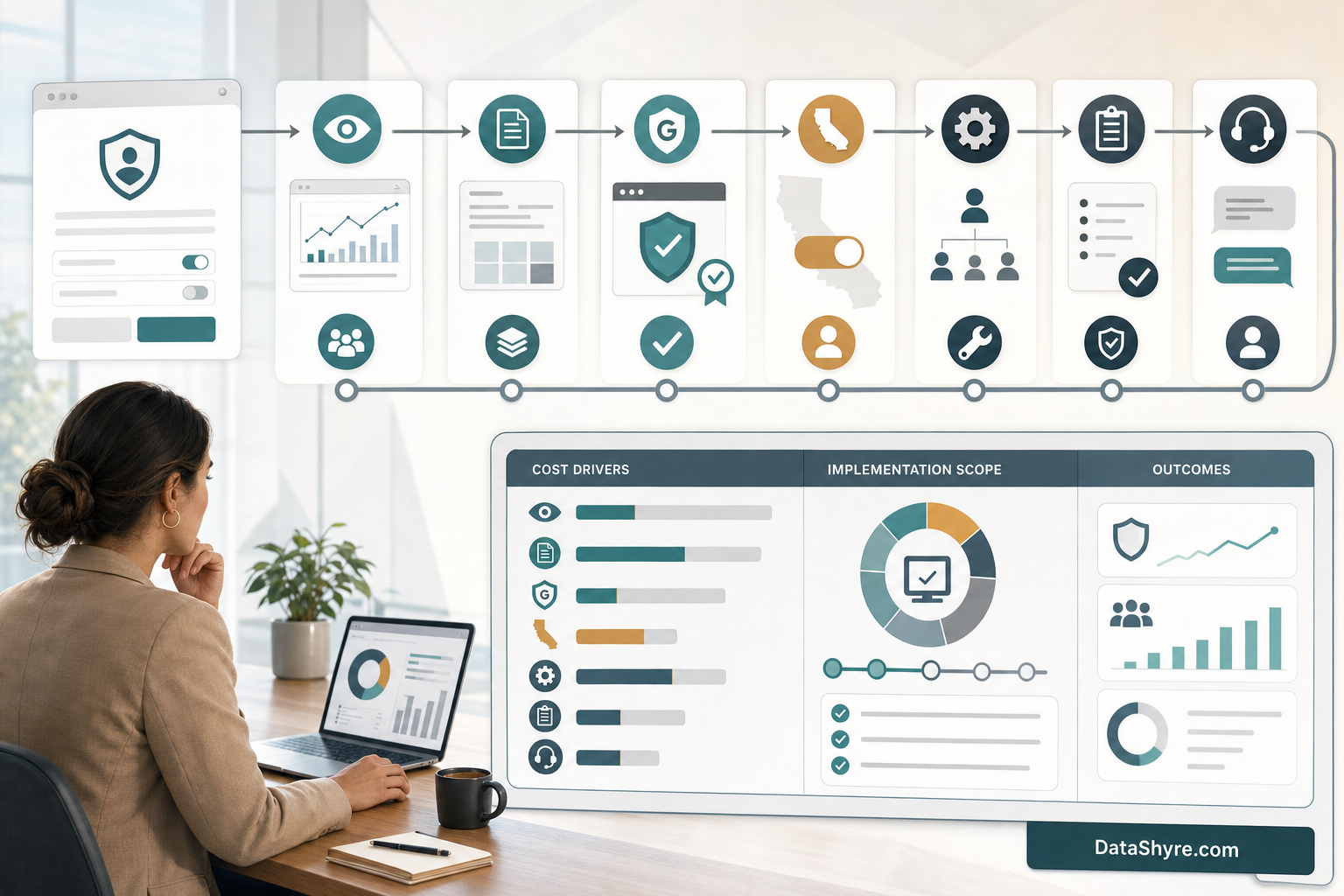
In plain English, your bill is not only software. It is also:
- tag-manager changes;
- direct-script cleanup;
- embed blocking;
- QA in real browsers;
- retesting after site changes.
That means the true cost should include one-time and recurring implementation work. A cheaper subscription can still be the more expensive choice if the product leaves your team doing custom runtime control around it.
6. Price proof, change management, and contracting
Strong CMPs do more than show a banner. They help teams explain what the user saw, chose, and changed later.
That operational layer can move pricing far more than buyers expect. CookieYes’s public enterprise page says enterprise plans add higher capacity, custom NDAs, DPAs and MSAs, security and vendor reviews, guided onboarding, and dedicated support, and that those plans are billed annually and invoiced up front.
This matters because the real procurement question is often larger than the listed software price alone. You may need:
- consent logs and reports;
- multi-user controls;
- higher scan depth or scheduled scans;
- security questionnaires and vendor review;
- contract negotiation support;
- change management after launches or new vendors.
A self-serve plan can be a good fit. It just is not the same purchase as a CMP expected to survive legal review, procurement review, and large-scale operations review at the same time.
7. Build a simple cost model before you sign
The best way to evaluate consent management platform pricing is to stop reading the vendor page like a shopping catalog and start treating it like an operating model.
I would build the cost estimate in this order:
- pricing meter: pageviews, subpages, domains, or annual contract;
- required compliance scope: EU or UK prior consent, California opt-out, GPC, publisher ads;
- technical work: GTM, direct tags, embeds, app or account linkage;
- operational proof: scans, logs, reporting, reconsent, user roles;
- procurement overhead: security review, custom contracts, onboarding, support.
That five-part view is usually enough to expose whether the “cheap” option is only cheap before implementation.
FAQ
Is a free CMP plan enough?
Sometimes. If you have one small site, modest traffic, simple tracking, and no demanding publisher or multi-region requirements, a free or low-cost plan may be enough. But once you need GPC handling, geo-targeting, TCF support, or deeper scanning, pricing often moves out of the entry tier quickly.
Is pageview pricing better than page-count pricing?
Neither model is automatically better. The right answer depends on your traffic shape, URL count, and number of domains. This is why checking the billing meter should happen before you compare monthly totals.
When do enterprise CMP plans make more sense?
Usually when you have many domains, heavy traffic, procurement requirements, custom contracts, security review, or a need to prove consent operations across multiple teams and properties.
Bottom line
Good consent management platform pricing in 2026 is not only about the subscription number.
It is about whether the pricing model matches your traffic and site structure, whether the plan supports the legal branches you actually need, whether Google publisher requirements or California opt-out complexity change the shortlist, and whether your team has budgeted for the implementation and proof work that makes a CMP real.
Seen clearly, consent management platform pricing is less about a pop-up and more about whether the site behaves honestly after the visitor makes a choice.
Sources
- European Commission, legal grounds for processing data: https://commission.europa.eu/law/law-topic/data-protection/information-business-and-organisations/legal-grounds-processing-data_en
- ICO, final storage and access technologies guidance published: https://ico.org.uk/about-the-ico/media-centre/news-and-blogs/2026/04/final-storage-and-access-technologies-guidance-published/
- ICO, how do we manage consent in practice?: https://ico.org.uk/for-organisations/direct-marketing-and-privacy-and-electronic-communications/guidance-on-the-use-of-storage-and-access-technologies/how-do-we-manage-consent-in-practice/
- Google for Developers, set up consent mode on websites: https://developers.google.com/tag-platform/security/guides/consent
- Google AdSense Help, consent management requirements for publishers: https://support.google.com/adsense/answer/13554116
- California DOJ, CCPA and Global Privacy Control: https://oag.ca.gov/privacy/ccpa
- California DOJ, Disney settlement announcement: https://oag.ca.gov/news/press-releases/california-wont-let-it-go-attorney-general-bonta-announces-275-million
- CookieYes, pricing and plans: https://www.cookieyes.com/pricing/
- CookieYes, enterprise CMP: https://www.cookieyes.com/enterprise/
- Cookiebot, pricing and plans: https://www.cookiebot.com/en/pricing/
—
Published: October 21, 2026. Updated using current official regulator, government, Google, and vendor pricing materials available at publication time.